Dopethrone: Three Songs, One Studio in Dorset, and the Throne Nobody’s Taken Back
They went into Chuckalumba with three songs finished and came out with 71 minutes that still set the bar for heavy. Decibel ranked it the second-best stoner rock record of all time, and Terrorizer called it the album of the decade. This is how three broke, feuding guys from Dorset made the doom record everyone else still gets measured against.
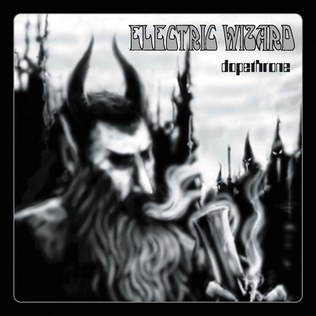
- THE RECORD · Dopethrone, Rise Above Records · UK autumn 2000 (sources differ: Sep 25 vs “October”)
- AMERICA · The Music Cartel, mail order from Nov 20, 2000 · in stores January 2001
- THE TRIO · Jus Oborn (vocals, guitar, lyrics) · Tim Bagshaw (bass) · Mark Greening (drums)
- THE ROOM · Chuckalumba Studios, Dorset · producer Rolf Startin
- THE RUN · 8 tracks · 71:08 · the closing title track alone runs 20:48
- RECEIPTS · Decibel: #2 stoner rock album of all time (2007) · Terrorizer: album of the decade (2009)
If you somehow made it this far without Electric Wizard, start here, and clear your afternoon.
The band came out of Dorset in 1993: Jus Oborn on guitar and vocals, Tim Bagshaw on bass, Mark Greening on drums. They made a self-titled debut, then Come My Fanatics… in 1997, which is the record where the doom got its space-rock acid bath. Then the Chrono.Naut and Supercoven EPs. Rise Above’s Lee Dorrian wanted a third album. The band wanted to make it when they were ready, which isn’t the same thing.
“This isn’t pop music, where there’s commercial pressure to deliver all the time. This is underground metal where, if you’re lucky, you might sell one or two copies.”
This post isn’t about the bongs. Every story about this record is about the bongs. It’s about how the record got built.
Here’s how. When they walked into Chuckalumba Studios in May 2000 they had three songs finished: “Dopethrone,” “Funeralopolis” and “We Hate You.” Oborn told Metal Hammer that “We Hate You” was inspired, in reverse, by Ozzy: “He was always going about how much he fucking loved everyone, so we thought it would be great to go and do the opposite.” The title track came from a story he’d heard about a sofa made entirely of dope. The record’s 15-minute centrepiece, “Weird Tales,” with its three movements — “Electric Frost,” “Golgotha” and “Altar of Melektaus” — didn’t exist until they were in the studio. When Oborn finally called Dorrian to say they were ready, the label boss answered, by Oborn’s account, “About fucking time!”
Accounts differ on how long the sessions ran. Wikipedia’s history, built mostly on Decibel’s 2007 feature, has the tracking done in a matter of days in May and June. Oborn told Metal Hammer they were in the room “for a few months. Not all at once.” Both can be true: tracking was fast and mixing was a war. Producer Rolf Startin knew the gear, and Oborn made himself the one in the band who sat beside him.
“I got a lot of ideas from watching Pink Floyd videos, especially the way they set up their microphones. I spent ages working out the best way to mic up my amps.”
Gear people, read that twice. The record Terrorizer would name album of the decade was miked by a guy studying how Pink Floyd set up a room. Oborn also says there’s more going on in the mix than people give it credit for: “A number of sonic layers that had to be built up.” He wrote every lyric, out of H.P. Lovecraft’s stories and his own altered state: “The irony was that he wrote while straight, influencing someone like me, who certainly was not.”
The cracks were already showing. Oborn told Metal Hammer that Bagshaw and Greening wanted to bring Nirvana and rap influences into the band, and that things “got very heated in the studio.” In his own words, “it was only later on that I realised this was the beginning of the end.” All three were quitting full-time jobs at the same time, with the money pressure that comes with that. Greening and Bagshaw were gone after 2002’s Let Us Prey.
The sleeve: Oborn’s idea, a Satanic figure getting stoned. He did a basic line drawing, and Tim’s brother Tom Bagshaw painted the version you know. Oborn wanted “a nightmarish, Lovecraftian, early 1970s quality.” The slogan on the back, Legalise Drugs and Murder, was “my nonsense,” he says.
Then the road. Dopethrone came out on Rise Above in autumn 2000. The band toured England and Europe with Sons of Otis, then went to America in March 2001, with Warhorse along for most of it. They were the first Rise Above band ever to tour the States. The run started March 4 and ended April 8 at South by Southwest. In between, all three of them got searched and questioned by police in Richmond, Virginia.
Then the ranking lists started. Decibel put it at #2 on its Top 20 Stoner Rock Albums of All Time in 2007. Terrorizer named it the album of the decade in December 2009. Metal Hammer put it at #31 on its 100 greatest metal albums of the 21st century in 2018.
One collector’s note. The 2004 reissue added the Japanese bonus track “Mind Transferal,” and somebody quietly cut the 20-minute title track down to about ten. Asked about it in 2007, Oborn said he hadn’t known. Track down an original.
“I feel we captured something special. Sure, there are flaws with the record, and I know we could have made it a lot better. But this is where Electric Wizard should be.”
Twenty-six years on, that’s where everyone else measures from. Cue the title track below and argue in the threads: is Dopethrone the throne, or does Come My Fanatics… get the crown? And who’s come closest since? Don’t be polite about it.
Receipts · Sources
1. Malcolm Dome, “How stoner-doom kings Electric Wizard made the classic Dopethrone album,” Metal Hammer via Louder (originally Metal Hammer #162) — all Oborn quotes, the studio account, the sleeve, the slogan.2. Wikipedia: Dopethrone — release dates, personnel, tour history, reissue note, accolades (citing Decibel 2007 and Dome 2011).
3. Electric Wizard — Topic: “Dopethrone” official audio (embed verified via oEmbed).
Where sources disagree (UK release date, session length), both accounts are reported above. Skip, don’t pan; correct in place. — The Desk